Wooden Wisdom
7 Timeless Lessons Humans Can Learn from Trees
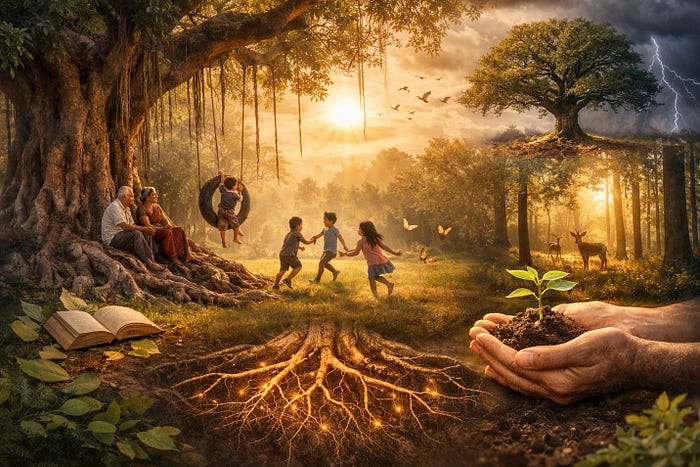
Trees are among the most magnificent creations of the universe. They have been mankind’s oldest allies since time immemorial. These standing sentinels silently watch our growth, our longings and aspirations, our joys and sorrows. They come in countless shapes and sizes and are found everywhere: in dense jungles and quiet forests, in bustling cities and remote villages, across peasantries, and even on distant islands. They have stood steadfast through changing eras, offering shade, sustenance, and solace. Trees are not just part of our environment — they are silent life coaches, teaching us patience, resilience, and endurance.
For many of us, trees are more than part of the landscape. They serve as living threads that connect us to our most cherished memories. Whenever I wander through the memory lanes of the past, the most vivid image that arises is that of a grand Banyan tree standing before our ancestral home down in the countryside. Beneath its vast and cooling shade, we used to play from dawn to dusk, our laughter echoing through the air. The elders would sit around the tree, watching us fondly; their smiles were immersed in the memories of their own childhood. That old Banyan tree, with its spreading branches and aerial roots, seems to hold the very spirit of our own little world.
It brings home the point that though human life is fleeting, the continuity of nature endures through generations. The Banyan tree lives for decades and carries the memories of bygone eras. In this way, it forms a connection between the past and present.
It is impossible not to admire and reflect on our existence alongside trees. They silently instruct us with profound lessons about resilience, adaptability, generosity, interconnectedness, and the power of community.
1. Patience in Growth
Trees grow slowly and steadily over time, often taking years to reach their full potential. This gradual growth teaches us the importance of taking things one step at a time. As a tree stems from a tiny seed and grows into a towering giant, similarly, every monumental venture starts with a small step. All we need to do is not rush and simply trust the process.
An oak tree, for instance, does not reach its full stature in the first year of its spring. In a fast-paced world, trees remind us that lasting achievements often require time, patience, and persistence. Just as the growth of a tree cannot be hurried, personal growth and character building require patience and long-term commitment. Mighty empires and ancient civilizations were not built in a day; they required the blood and sweat of people who, for the sake of their country, “stand fast and suffer long.” Similarly, the silent trees reinforce the lesson that “those also serve who stand and wait,” meaning that service to God and to others is not limited to active deeds but also includes patience, endurance, and quiet waiting.
2. Resilience in Adversity
Trees stand firm against the test of time, weathering storms and adapting to various conditions. Shakespeare reminds us in King Lear:
“The oaks, whose boughs so many blasts have worn, still stand.”
Trees teach us the value of resilience, reminding us that challenges are merely seasons that pass. Just as trees bend but do not break, we too can learn to navigate life’s difficulties with grace and dignity. They impart lessons in resilience and exemplify the art of transforming setbacks into opportunities for growth.
3. The Art of Giving
Trees provide us the clean air we breathe, the shade we seek, and the resources we use in our daily lives. They offer shelter and sustenance to countless creatures, embodying the spirit of selfless giving. In their acts of generosity, trees remind us to cultivate a more compassionate and giving mindset in our interactions with others and with the world around us.
4. Growth Through Change
Seasons change, and so do trees. They blossom in spring, shed their leaves in autumn, and bear the harshness of winter, yet they embrace each season with renewed hope that spring will come. Through their subtle transformations, they teach us that growth often requires letting go of the past to make room for the new.
Trees remind us that both growth and learning involve accepting change and adapting to new circumstances. They help us understand the evolution of societies, cultures, and civilizations over time. Above all, they empower us to see that change is the only unchangeable law of nature — that we grow and transform only when we adapt to varied situations and adverse conditions.
Just as trees release their leaves in autumn, we too must learn to let go of past grudges, old enmities, and even outdated versions of ourselves, to become better and more evolved human beings. Philip Larkin, in his poem The Trees, reflects on renewal and mortality:
“Last year is dead, they seem to say
Begin afresh, afresh, afresh.”
5. Generous and Caring
Trees discourage uneven development. They distribute essential nutrients to their neighboring trees through their roots, helping the growth of the weaker ones. In this way, no part of the jungle remains neglected. Humans, on the other hand, often lack this capacity for sharing. We have become slaves to greed, and the world is divided into haves and have-nots. If we could just learn this trait of selfless giving from trees, this world would become a better place to live.
6. Power of Community and Interconnectedness
In jungles, trees help each other grow. Trees grow collectively, survive storms, floods, and heat due to this shared system of care. Even nature’s fury often strikes trees that try to live alone; a solitary tree is more likely to be hit by lightning. As John Donne reminds us,
“No man is an island.”
The same applies to trees. Beneath the surface, they create an intricate network of roots that not only support themselves but also share resources with neighboring trees.
The movie Train Dreams also aptly reflects on it,
“In the forest, every least thing’s important. It’s all threaded together. So you can’t tell where one thing ends and another begins.”
These lines tend to emphasize the importance of interconnectedness and the power of community. Similarly, in our lives, we should build connections in order to live a better and more meaningful life, understanding that our actions ripple far beyond ourselves.
7. Respecting Mother Nature
Trees are an integral part of our natural environment and exemplify the concept of living in harmony with the earth. They don’t exploit their surroundings; instead, they coexist and thrive within the ecosystem, playing a pivotal role in maintaining the balance of our planet.
In the same way, we should respect and care for our environment. We should be aware of the delicate ecological balance and the consequences of environmental degradation. Trees give us clean air and a stable climate. They also impart the lesson that we should take upon ourselves the responsibility of being stewards of the earth. They illustrate that protecting our environment is not a choice but a duty we owe to future generations. Just as teachers shape our minds, trees shape the very landscape of our existence.